 I like feeds and APIs.
Feeds and APIs provide ways for others to access a service and to recombine the data in new and unexpected ways. Ways that have consistently been proven to be beneficial to both parties (which makes google’s increasing antipathy towards them an interesting, not to mention short sighted, trend).
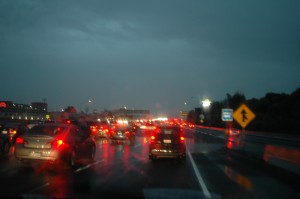
Anyway, it was one morning when I was attempting to find a route to work for my girlfriend which bypassed the numerous arterial route crashes that had happened that morning and I found myself pondering thus…
… wouldn’t it be cool if roads and junctions had permanent URLs, and better yet if you could get a data feed on them?
This would let you do many cool things, for example you could enter your route to work and get a status of the traffic en route – or at the very least attach a particular traffic blackspot (in our case the 13 bends of death on the A4074) to ifttt and get SMS alerts if there was a problem.
Giving roads and junctions addressable urls would be an obvious extension to the google maps API, but given that Google won’t even let you embed a map in a page if it contains a traffic data overlay it seems unlikely they’ll provide such access to their data. Other sources such as the Yahoo’s traffic API has long since been shut down.
So, what alternative traffic data sources could we use?
One possible data source we could use would be to parse a twitter search for the road in question. We both currently use ifttt hookups to get alerts for certain key roads, so the basic concept is sound.
This isn’t perfect, for example there is no understanding of the context of a message – so for example a message saying “No traffic problems on the A4074” and “Terrible crash on the A4074” would both trigger the alert, but only the latter would indicate a problem.
The other problem of course is that it also relies on people tweeting, but in effect this would actually pull in quite a diverse range of secondary sources – in my case, for example, it also pulls in any source that feed into the local radio station – which includes reports from their traffic spotter plane.
As an individual without access to data from traffic sensors, or any ability to collect data directly (unlike, say, google who can use position reports from android phones), we are pretty much limited to collecting data from secondary sources as far as I can see.
What other sources could we use?






 Otto von Bismarck once said: “